
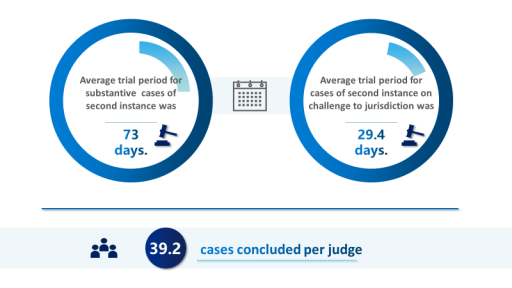
In 2019, the average trial period for substantive cases of second instance tried by the IP Court was 73 days, and 29.4 days for cases of second instance on challenge to jurisdiction. The closing rate was 39.2 cases per judge.
⑤ Statistical analysis of cases involving a party from foreign country, Hong Kong, Macau, and Taiwan Region
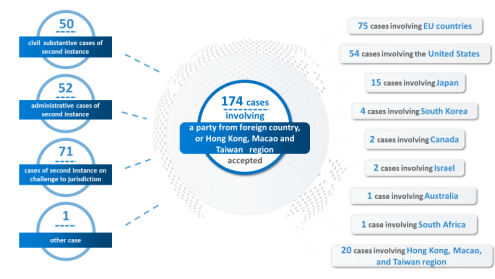
In 2019, the IP Court accepted 174 cases involving a party from foreign country, Hong Kong, Macau, and Taiwan region. Among them, there were 50 civil substantive cases of second instance, 52 administrative cases of second instance, 71 cases of second instance on challenge to jurisdiction, and 1 other case. By region, there were 75 cases involving EU countries, 54 cases involving the United States, 15 cases involving Japan, 4 cases involving South Korea, 2 cases involving Canada and Israel, respectively, 1 case involving Australia and South Africa, respectively, and 20 cases involving Hong Kong, Macau and Taiwan.
The IP Court concluded 98 cases involving a party from foreign country, Hong Kong, Macau, and Taiwan region. Among them, 35 substantive cases were concluded, of which 21 were won by foreign parties (including partially won), 3 were won by Hong Kong, Macao and Taiwan parties, and 11 were won by parties of the Chinese mainland.
(2) Case characteristics analysis
① Overall characteristics of cases
In 2019, technology-related IP cases tried by the IP Court share the following characteristics: they involve a wide range of technologies; they have a large social impact; many of them involve interconnected procedures; the trial period is short; the legitimate rights and interests of Chinese and foreign parties are equally protected; and the direction for increasing the judicial protection is clear.
(i) The cases involve a wide range of technologies. The types of intellectual property rights claimed by the parties involve many fields that are closely related to national economy, people’s livelihood, cutting-edge technology, clothing, food, housing, and transportation, including medicine, gene, telecommunications, machinery, agriculture, and forestry.
(ii) The cases have a large social impact. One is the high market value of the intellectual property involved in the cases. There are 17 cases of first instance in which the obligee claimed infringement damages of over RMB 10 million, including 3 cases with claims over RMB 100 million. Two is the high degree of attention from society when the cases involve cutting-edge technologies or national economy and people’s livelihood, such as standard essential patents (SEPs), pharmaceutical patents, etc.
(iii) The cases involve interconnected procedures. The IP Court accepted many mutually competitive litigation cases where the parties file multiple civil and administrative litigations against each other in different courts. There were many related cases involving different trial levels and different procedures. The IP Court achieved good results by coordinating and handling the cases from the aspects of trial procedures, judgment standards, holistically mediation, etc., and the percentage of mediation and withdrawal rate of second instance cases concluded in 2019 was 29.9%.
(iv) The trial period of the cases is short. Due to various factors such as interconnected civil and administrative procedures, and difficulty in finding technical facts, the trial period for technology-related IP cases is generally longer. However, the average trial period for substantive cases of second instance concluded by the IP Court in 2019 was only 73 days, which indicated that the trial period for cases involving the protection of technology-related intellectual property rights had been considerably shortened.
(v) The legitimate rights and interests of Chinese and foreign parties are equally protected. The cases involving a party from foreign country, Hong Kong, Macau, and Taiwan region accounted for 8.9% of all cases accepted by the IP Court. Some of the cases were part of transnational litigation between the parties, which interplayed with foreign patent infringement litigation and together constituted an integral part of the parties’ business competition strategy. The IP Court continues to insist on equal treatment and equal protection of the intellectual property rights of both Chinese and foreign market entities of various types, according to law.


